
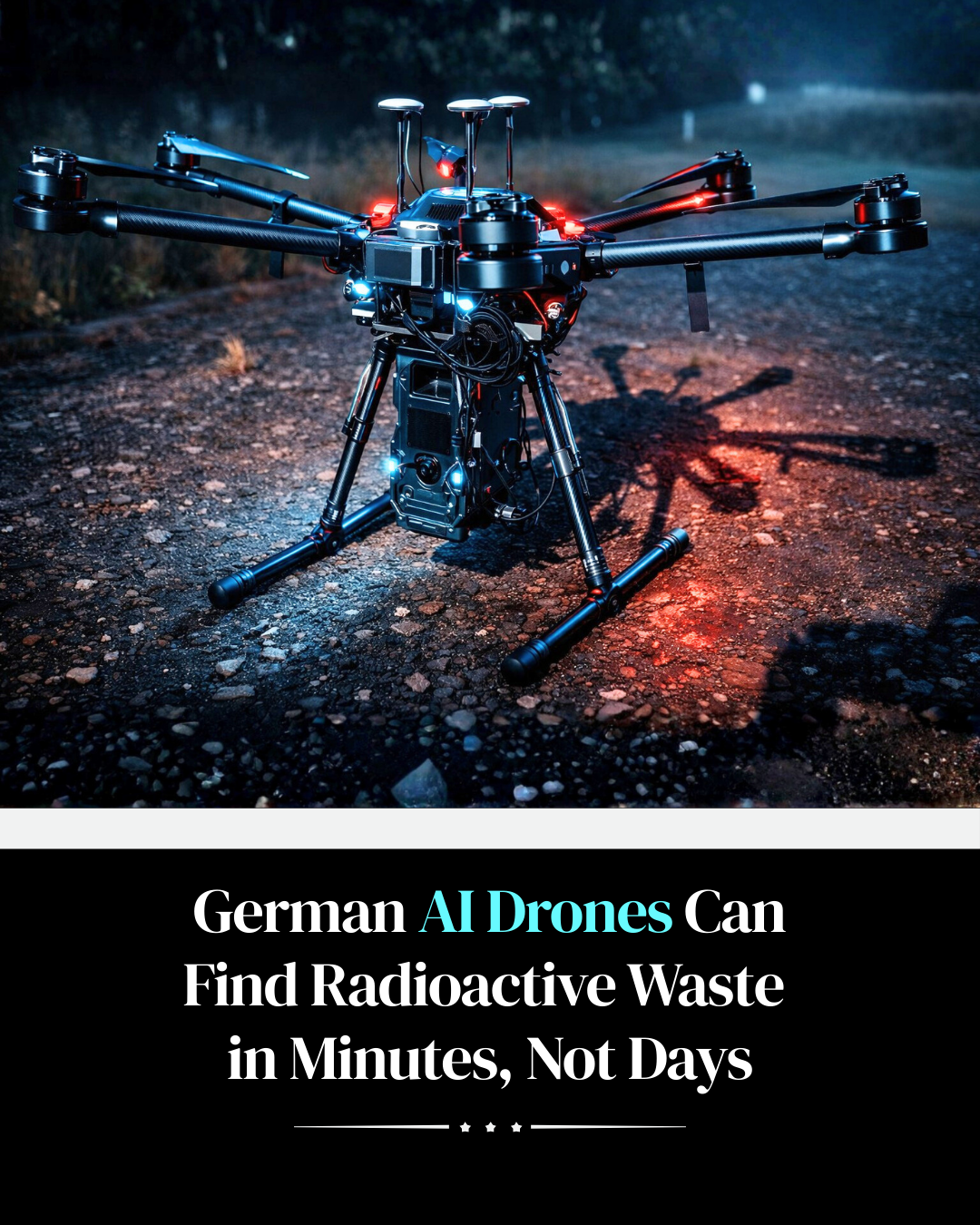
Hazardous radiological searches have traditionally required slow, high-risk, ground-based operations. The reference describes a German research approach that replaces much of that exposure with AI-enabled drones and robots. The system combines gamma radiation sensors with infrared and optical cameras, then streams real-time readings into probabilistic algorithms that update likely source locations continuously. When anomalies appear, drones shift from fixed routes to adaptive search, recalculating flight paths until localization converges with high precision. Ground robots then enter high-risk areas to confirm, map contamination, and retrieve objects using robotic arms and operator-friendly controls. The operational impact is a step-change in speed: tasks described as taking days can be reduced to minutes. The strategic takeaway is not only automation, but sensor fusion and algorithmic search as the mechanism that compresses response time while improving safety by keeping humans out of hazardous zones.
Radiological threats create a distinct operational challenge: the environment is dangerous, the search space can be large, and uncertainty is costly. Conventional approaches often rely on humans moving through exposure zones with handheld detectors, which can be slow and risky. The reference outlines an alternative architecture where machines perform the initial search and localization. Drones equipped with gamma sensors and imaging payloads collect complementary signals and relay them in real time. Probabilistic algorithms integrate these inputs to estimate where a source is most likely located and refine that estimate as new measurements arrive. Once an anomaly is detected, the drones adjust their routes autonomously to increase signal quality and reduce uncertainty. This shifts the response model from manual scanning to algorithmic convergence. Ground robots then handle confirmation, mapping, and retrieval, reducing the need for human entry into high-risk areas.
Emergency response, critical infrastructure protection, and hazardous materials handling are increasingly adopting robotics to reduce human exposure and increase operational speed. Radiological search is a particularly suitable use case because sensor data is measurable, environments can be constrained, and safety costs are high. The reference points to a broader pattern: autonomy is moving beyond navigation into decision support, where systems choose where to search next based on uncertainty reduction. This aligns with wider developments in sensor fusion, real-time inference, and human-machine interfaces that allow remote supervision rather than direct intervention. As these systems mature, they may influence standard operating procedures for fire services, civil defense, nuclear facilities, and border security. Adoption will depend on reliability, regulatory acceptance, and the ability to integrate with existing incident command workflows. The operational value proposition is clear: faster localization reduces exposure windows, limits spread, and improves decision-making under time pressure.
The reference highlights several observable operational design elements:
These elements collectively explain the speed improvement: sensor fusion and algorithmic search reduce uncertainty faster than manual sweeps.
For robotics and AI startups, the reference suggests a clear product pattern: build systems that turn multi-sensor data into actionable decisions under uncertainty. The opportunity is not only hardware but the autonomy layer—probabilistic localization, adaptive planning, and reliable handoff between aerial and ground platforms. Startups can differentiate by improving how quickly systems converge on a source, how robust they remain in cluttered environments, and how easily operators can supervise without deep technical training. Integration also matters: customers in safety-critical domains require auditability, predictable failure modes, and strong validation. The use case supports modular business models: sensor packages, autonomy software, mapping tools, and retrieval robotics. However, sales cycles may be long, requiring partnerships with public agencies, industrial operators, or system integrators. Teams that can demonstrate time-to-localize improvements and clear safety gains will have stronger procurement narratives than those emphasizing autonomy in general terms.
For investors, radiological detection robotics is a high-stakes niche with potential for broader spillover into defense, industrial inspection, and hazardous response. The core investment question is whether the system’s advantage is defensible and measurable: reduced time-to-localize, reduced exposure hours, and improved incident outcomes. Differentiation may sit in proprietary sensor fusion pipelines, probabilistic search algorithms, or validated datasets from field deployments. Investors should also examine commercialization pathways. Customers in public safety and regulated infrastructure require reliability evidence, certifications, and service capacity. This increases barriers to entry but extends timelines. Another consideration is platform strategy: solutions that generalize from radiological search to chemical detection, structural assessment, or disaster response may expand market size. Risk factors include deployment robustness, regulatory constraints on drones, and the operational complexity of multi-robot coordination. Strong teams will show field performance, clear interfaces for operators, and integration into existing emergency workflows.
Operational autonomy in hazardous environments carries reliability and governance risks. False positives can waste response capacity, while false negatives can prolong exposure. Sensor fusion improves context, but performance depends on calibration, environmental conditions, and interference. Drone operations are also subject to regulatory limits, especially in urban or restricted zones. Multi-robot coordination introduces additional failure points: communications loss, localization drift, or route planning errors. Another open question is retrieval governance. Even with robotic arms, safe handling procedures and chain-of-custody requirements must be maintained, which may require human oversight and specialized protocols. Adoption will likely depend on consistent field validation and clear evidence that systems reduce risk without introducing new operational hazards. Finally, economic feasibility matters: agencies must justify procurement and maintenance costs relative to current methods, even when safety benefits are high.
The reference indicates a direction of travel: hazardous search is shifting from manpower-intensive sweeps toward machine-first localization. As sensor fusion improves and probabilistic planning becomes standard, response time reductions may become repeatable across environments. The near-term trajectory is likely hybrid autonomy: drones and robots perform search and localization while humans supervise decisions, define boundaries, and manage escalation. Over time, integration with mapping and incident command systems could make autonomous localization a default capability for certain emergency classes. The broader implication is standardization: if systems consistently reduce response time and exposure, agencies may adopt them as baseline equipment, similar to how thermal cameras and drones have spread in fire response. Whether this becomes global standard practice depends on field reliability, regulatory compatibility, and procurement capacity. The technical pathway appears clear, but scaling will be determined by operational trust and integration quality.
Q1: How do AI drones localize radioactive sources faster?
They combine gamma radiation readings with infrared and optical data, then use probabilistic algorithms to refine likely source locations continuously. Adaptive flight paths focus measurements where uncertainty is highest.
Q2: Why is sensor fusion important in hazardous searches?
Single sensors can be ambiguous. Fusing multiple signals improves context, reduces uncertainty faster, and supports more reliable decisions about where to search next.
Q3: What role do ground robots play after detection?
They enter high-risk areas to confirm threats, map contamination, and retrieve objects using robotic arms. This reduces the need for humans to enter hazardous zones.
Q4: What could prevent wide adoption of this approach?
Reliability requirements, drone regulations, integration with emergency workflows, and cost justification can slow adoption. Field validation and operational trust are critical.
The reference challenges a longstanding assumption: radiological threats require slow, dangerous, boots-on-the-ground searches. A German research approach combines AI-enabled drones and ground robots to detect and localize radioactive sources in hazardous zones where human entry is unsafe. The system fuses gamma sensors with infrared and optical cameras and uses probabilistic algorithms to update likely source locations in real time. When anomalies appear, drones shift from preset routes to adaptive search, recalculating paths until localization converges. Ground robots then confirm, map contamination, and retrieve objects using robotic arms. The operational value is speed and safety: searches described as taking days can be reduced to minutes while keeping humans out of exposure zones. If reliability and integration challenges are met, this model can set a new baseline for hazardous response.