
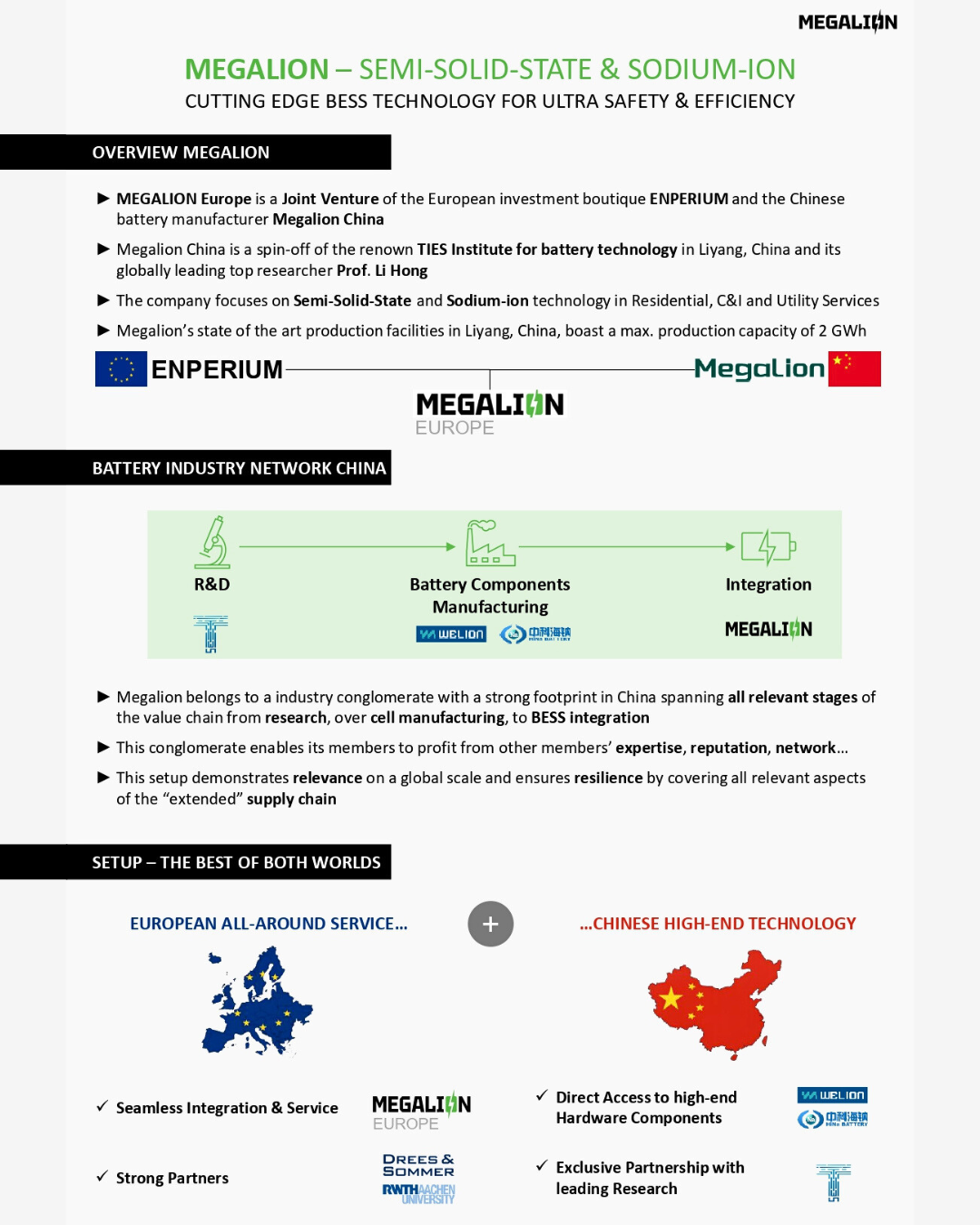
Battery energy storage has often been treated as a commodity layer in the energy transition. That framing is increasingly insufficient. A structural shift is underway toward semi-solid-state and sodium-ion architectures designed for grid safety, resilience, and long-term performance rather than laboratory optimization alone. The reference highlights a vertically integrated model that connects European system integration with Chinese battery research and manufacturing scale. Instead of betting on a single breakthrough, the approach de-risks the full stack—from research and cell production to battery energy storage system integration across residential, commercial, and utility segments. The central shift is strategic rather than purely economic. This is not primarily about lower cost per kilowatt-hour. It is about safer chemistries, supply chain resilience, and performance control at scale. As grids modernize, safety and integration capability are becoming defining performance metrics.
Energy storage plays a foundational role in grid stability, renewable integration, and electrification. Conventional lithium-ion systems have scaled rapidly, but growing deployment has also highlighted safety, supply concentration, and performance constraints under diverse operating conditions. Semi-solid-state and sodium-ion chemistries are emerging as alternatives aligned with safety-first grid design. Semi-solid-state architectures aim to improve thermal stability and structural integrity, while sodium-ion systems reduce reliance on lithium and other constrained materials. The reference emphasizes integration as a differentiator. Battery innovation alone is insufficient without manufacturing capability, capital support, and deployment experience across use cases. When chemistry, cell production, and system integration are aligned within a vertically coordinated model, risk can be reduced across the value chain. This reframes battery storage from a component purchase to an infrastructure strategy.
Global demand for battery energy storage systems is expanding across residential, commercial and industrial, and utility-scale applications. Grid operators increasingly prioritize safety, fire resistance, and lifecycle stability alongside energy density and cost. Regulatory scrutiny around battery installations has intensified, reinforcing the importance of safer chemistries. At the same time, supply chain concentration has exposed vulnerabilities in critical materials sourcing and manufacturing capacity. Sodium-ion chemistry presents an alternative pathway that leverages more abundant materials, potentially improving resilience. Semi-solid-state approaches seek to balance performance and stability, offering incremental improvements without waiting for fully solid-state breakthroughs. The competitive landscape is shifting toward integrated providers capable of managing R&D, cell production, and BESS deployment. Vertical integration is becoming a strategic moat as storage systems evolve from standardized modules into safety-critical infrastructure assets.
The reference outlines several structural dynamics:
These factors collectively indicate that battery technology is transitioning from commoditized hardware to strategically controlled infrastructure.
For startups operating in energy storage, differentiation may increasingly depend on integration capability rather than isolated chemistry advances. Opportunities exist in safety engineering, thermal management, battery management systems, and lifecycle analytics that support new chemistries. Teams developing sodium-ion or semi-solid-state technologies must also address manufacturability and system compatibility. Partnerships with established integrators can accelerate deployment and validation. Startups positioned within the vertical stack—materials, cell design, software optimization, and installation services—can create defensible niches. However, capital intensity and certification requirements remain significant barriers. Success requires alignment with grid operators and regulators, ensuring compliance and safety standards are met. The shift toward infrastructure-grade storage means startups must think beyond laboratory validation and toward scalable, integrated deployment models.
For investors, battery innovation is no longer solely a chemistry bet. The competitive question increasingly centers on who controls the value chain. Vertically integrated models may reduce exposure to material price volatility, manufacturing bottlenecks, and system integration failures. Sodium-ion systems offer diversification from lithium supply risk, while semi-solid-state architectures provide incremental safety improvements without waiting for fully solid-state maturity. Investors should assess integration depth, manufacturing partnerships, and deployment pipelines rather than focusing exclusively on laboratory performance metrics. The risk profile includes technology validation, regulatory acceptance, and scaling execution. However, as grid operators prioritize safety and resilience, providers that align chemistry innovation with deployment capability may capture durable market share. Capital allocation decisions should consider long-term infrastructure positioning rather than short-term cost competition.
While sodium-ion and semi-solid-state systems are advancing, large-scale deployment data remains limited compared to conventional lithium-ion. Manufacturing transitions can introduce yield challenges and cost variability. Regulatory standards may evolve as new chemistries are adopted, potentially increasing compliance complexity. Additionally, vertical integration requires significant capital and operational coordination, which can introduce execution risk. Market adoption depends on demonstrated safety performance and lifecycle economics under real grid conditions. There is also competitive uncertainty, as alternative chemistries and hybrid systems continue to develop. The critical open question is pace: how quickly these architectures can scale while maintaining reliability and cost discipline. Adoption will depend on measurable performance improvements and consistent integration outcomes.
Battery storage is transitioning from a commodity layer to a strategic infrastructure domain. As electrification deepens and renewable penetration rises, grid operators will prioritize systems that combine safety, resilience, and supply chain security. Semi-solid-state and sodium-ion technologies are positioned to contribute to that transition by addressing thermal stability and material diversification. Vertical integration models may become increasingly influential as deployment scales across residential, commercial, and utility segments. The competitive landscape will likely favor providers capable of controlling chemistry development, cell manufacturing, and system integration in a coordinated framework. The central strategic question is not whether battery technology will evolve, but which actors will command the integrated value chain when it does.
Q1: Why are sodium-ion batteries gaining attention?
Sodium-ion systems use more abundant materials, potentially improving supply chain resilience and reducing dependence on lithium.
Q2: What advantage does semi-solid-state architecture provide?
Semi-solid-state designs aim to enhance thermal stability and safety while maintaining competitive energy performance.
Q3: Why is vertical integration important in battery storage?
Controlling R&D, manufacturing, and system integration reduces risk, improves quality control, and strengthens long-term competitiveness.
The treatment of battery storage as a commodity is increasingly outdated. Semi-solid-state and sodium-ion architectures are emerging as safety-first, resilience-oriented alternatives to conventional lithium systems. The strategic differentiator is not simply chemistry innovation but integration depth across the value chain. Providers that combine research capability, manufacturing scale, and system integration expertise are positioned to shape the next phase of grid storage deployment. As safety and supply chain resilience become core performance criteria, battery systems evolve from standardized modules into infrastructure assets. The decisive factor will be which organizations control and coordinate the full stack when technological transition accelerates.